
Zero-coupon bonds don't give out interest but are issued at a deep discount to the face value, making it difficult to ascertain the net present value.

Providing comfort to the government on the revenue front amid fiscal stress, direct tax collection is moving closer to the revised Budget target for 2021-21 and may get a further thrust from the last instalment of the advance tax payment, the deadline for which ended on Monday. The contraction in net direct tax collection narrowed to 5 per cent year-on-year as on March 15 compared to a 9 per cent decline seen in January. In absolute terms, net collection stood at Rs 8.2 trillion against Rs 8.67 trillion in the same period last year, according to the provisional numbers shared by a government official.

The Cabinet has cleared a Bill to set up a government-owned development finance institution (DFI) with initial paid-up capital of Rs 20,000 crore so that it can leverage around Rs 3 trillion from the markets in a few years to provide long-term funds to infrastructure projects as well as for development needs of the country. To put it in perspective, Rs 3 trillion constitutes slightly less than 3 per cent of the Rs 111 trillion to be spent on over 7,000 projects in the National Infrastructure Pipeline from 2019-20 to 2024-25. Besides, the government will give Rs 5,000 crore as grant to the institution, Finance Minister Nirmala Sitharaman on Tuesday told the media after the Cabinet meeting.

The Department of Investment and Public Asset Management (Dipam) has asked ministries, government departments, and public sector undertakings (PSUs) to send a list of assets that can be monetised under the proposed National Monetisation Pipeline. The list will be used for creation of an asset monetisation dashboard, which will keep a track of such assets. The government, meanwhile, has asked CRISIL to prepare a road map for monetising assets of PSUs and government departments.

Senior officials in the MF industry say while the finance ministry and regulators communicate regularly, this is one of the very few instances in many years where an issue between the two has come out into the open.

Many states are open to the idea of petrol and diesel being brought under the goods and services tax (GST) regime - contrary to the perception that they are averse to it - but they want a concrete proposal, including a compensation mechanism, from the Centre. West Bengal Finance Minister Amit Mitra says while the issue can be discussed, the Centre may not be keen to bring the change because it earns "much more" from taxes on petrol and diesel. "(The peak rate of) GST is 28 per cent. Under the regime, the Centre would only get 14 per cent. "So, definitely, the Union government does not want GST on fuel. It is all lies. Currently, they are in a very cozy place," Mitra said.
The bank will now be in a position to resume normal lending activity, including corporate lending, with tightened risk management framework.
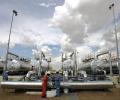
During a series of hectic talks between Cairn Energy and the Indian government over the $1.2-billion arbitration award in favour of the former last week, a slew of options was proposed by the two sides, including computation of capital gains and participation in the Vivad se Vishwas (VsV) dispute resolution scheme. The government is likely to go ahead and appeal against the arbitration award by a Permanent Court of Arbitration at The Hague before March 21, indicated finance ministry officials. Cairn Energy Plc on Sunday said it was hopeful that an acceptable solution to its tax dispute with the Indian government could be found to avoid prolonging and exacerbating the 'negative issue' for all parties.

Operationalising the ban is being fleshed out: it will entail which cryptocurrencies will be banned and how.

The government has revised its divestment target downwards from Rs 2.1 trillion, as its ambitious privatisation programme has been deferred to next year.

The government is set to divest its shareholdings in defence PSUs, Garden Reach Shipbuilders & Engineers Ltd and Mishra Dhatu Nigam Ltd (MIDHANI). It will also divest its shareholding in BEML Limited, said Shripad Naik. Minister of State for Defence, on Monday. The government has invited preliminary bids to sell its 26 per cent stake in BEML along with transfer of management control.

The Reserve Bank of India has issued several warnings that the public should not fall prey to such unscrupulous activities and verify the companies offering loans online and through apps.

The department of investment and public asset management (Dipam) can also seek in-principle approval from the Cabinet Committee on Economic Affairs (CCEA) for strategic divestment of PSUs on a case-to-case basis considering investor appetite and sectoral trends.

The number of centrally sponsored schemes have increased to 35 in FY22 from 30 in FY21 and central sector schemes have increased to 704 from 685 in the previous year, reports Dilasha Seth.

The Budget proposed abolishing the under-performing, authority of advance ruling, to replace it with a two-member board of advance ruling.

'It is just an excuse to say that the Centre has run out of money.' 'Pruning these schemes would mean hard time for the people of India.'

The policy was part of the Aatmanirbhar Bharat package announced by Sitharaman in May 2020 as a coherent policy where all sectors would be opened for private sector participation.

RRBs were formed under an Act to provide credit to small farmers, agricultural labourers and businesses in rural areas.

State-owned companies have been set stiff targets to increase accountability as they get ready for divestment. Nikunj Ohri explains why meeting them will be challenging.

While the tax-to-GDP ratio of 9.88 per cent has been assumed for FY21, the same as last year, when it touched a decadal low, for FY22 a ratio of 10.7 per cent has been assumed, an average of the last five years.
 © 2026 Rediff.com - Investor Information - Advertise with us - Disclaimer - Privacy Policy - Sitemap - Feedback - About us - Terms of use - Grievances